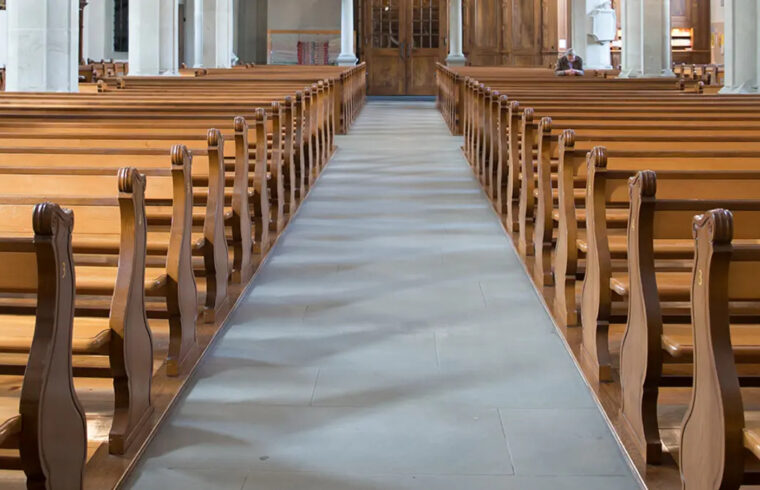
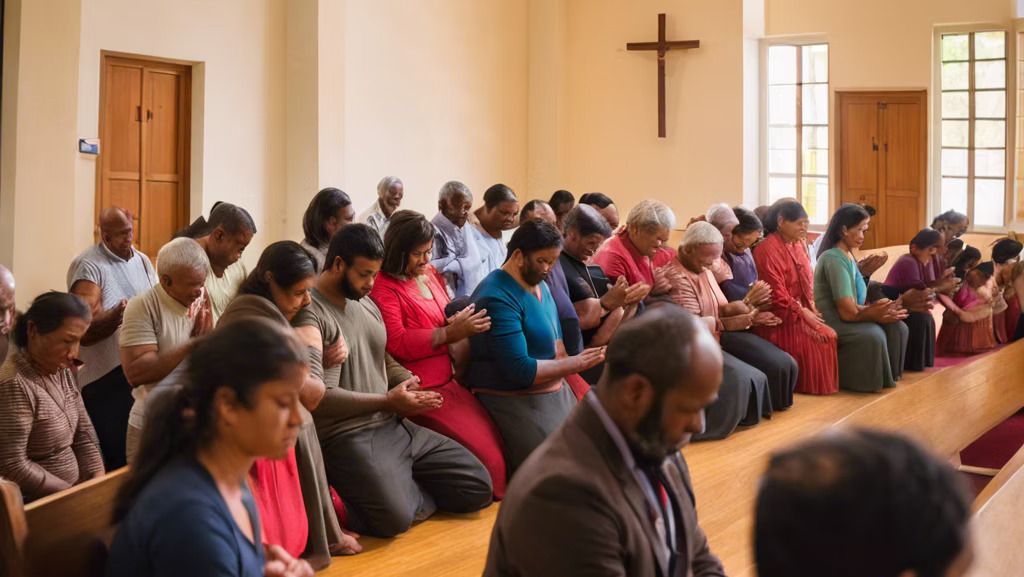
 Representational image of church pews. Photo credit: Shutterstock
The Church is called to be a community where human beings are received not according to caste, social status, family background, or political influence, but according to the grace of God. Yet, in many places, the reality experienced by Christian communities continues to reveal the deep influence of caste within the life of the Church.
A situation reported from a Lutheran congregation in Guntur raises serious questions about the persistence of caste-based divisions among Christians. According to accounts from members and observers, the congregation has experienced longstanding tensions between members belonging to the Mala and Madiga communities, both categorised as Dalits. These divisions are reported to influence not only relationships within the congregation but also questions of leadership and the exercise of ecclesiastical authority.
When Church Leadership Becomes a Question of Caste
One of the concerns reported from the congregation is a pattern in which leadership and clergy representation become closely associated with the caste group that holds greater influence within the congregation at a particular period.
It is alleged that when the Madiga community exercises greater influence for a particular five-year period, clergy leadership tends to be associated with the Madiga community, while a corresponding period of Mala influence results in leadership being associated with the Mala community.
If such a pattern is established, it raises a fundamental theological and ecclesiological question: Can leadership in the Church be determined primarily by caste identity and group power?
Christian ministry is not intended to function as a rotation of caste-based control. The New Testament presents the Church as one body in Christ: “For just as the body is one and has many members, and all the members of the body, though many, are one body, so it is with Christ.” | 1 Corinthians 12:12
The Church, therefore, cannot simply reproduce the social divisions that exist outside its walls.
Mala–Madiga Tensions and the Larger Question of Caste
It is important to recognise that the issue should not be reduced to a competition between Mala and Madiga communities. Both communities have their own histories, experiences, struggles, and identities within Indian society and Christianity.
The deeper concern is what happens when caste identity becomes the primary basis through which Christians understand belonging, leadership, representation, authority and dignity. When a congregation begins to think in terms of “our people” and “their people,” the Christian identity of the community is weakened.
Paul’s words in Galatians are particularly significant: “There is no longer Jew or Greek, there is no longer slave or free, there is no longer male and female; for all of you are one in Christ Jesus.” | Galatians 3:28
This does not mean that historical experiences and social injustices disappear simply because people become Christians. Rather, it means that the Church is called to confront those divisions and create a different social reality in Christ.
The Problem Is Larger Than One Congregation
The reported situation in Guntur should not be treated merely as an isolated internal dispute. It points toward a larger question confronting Indian Christianity: Has the Church sufficiently confronted caste, or has caste simply entered the Church under Christian names?
Conversion to Christianity does not automatically erase the social structures and prejudices that people have inherited from society. Caste consciousness can continue through marriage practices, social relationships, seating arrangements, burial grounds, leadership structures, institutional representation and even patterns of church administration. Therefore, the Church’s response cannot simply be, “We are all Christians.” The more difficult question is: Do our structures, practices and relationships actually demonstrate that we believe we are one in Christ?
From Representation to Transformation
Representation of different Dalit communities in church leadership is important. However, representation alone cannot solve caste discrimination. If one caste replaces another in exercising control, the fundamental problem remains. The goal should not be: “Which caste controls the Church?”
The goal should be: “How can the Church become a community in which no caste controls another?”
This requires transparent leadership processes, equal participation, accountability, theological reflection on caste, opportunities for members from different communities, and mechanisms through which grievances can be heard and addressed without fear. Church leadership must be based on calling, character, theological formation, pastoral commitment and the discernment of the Church, rather than simply on the numerical or political strength of a caste group.
A Biblical Challenge to the Church
James 2 gives the Church a particularly uncomfortable warning. James challenges Christians who give preferential treatment to some people while treating others differently. The Christian community is called to: “fulfill the royal law according to the scripture, ‘You shall love your neighbour as yourself.’”| James 2:8
The question for the Church today is, therefore, not merely whether caste discrimination exists outside Christianity. The question is whether the Church itself is reproducing discrimination in its own structures.
Ephesians 2:14 declares: “For he is our peace; in his flesh he has made both groups into one and has broken down the dividing wall, that is, the hostility between them.”
If Christ breaks down dividing walls, the Church must not rebuild them through caste consciousness.
A Call for Dialogue and Accountability
The reported situation in Guntur calls for serious, peaceful and transparent dialogue among the congregation, clergy and ecclesiastical authorities. Such dialogue should not become another opportunity for one community to defeat another.
Instead, it should ask:
- Are caste considerations influencing church leadership?
- Are members treated equally irrespective of caste?
- Are leadership opportunities genuinely accessible to all?
- Are church elections and appointments transparent?
- Are complaints of caste discrimination being properly heard?
- Does the congregation have an effective mechanism for resolving caste-based conflicts?
- How can Mala and Madiga Christians participate together without one community dominating the other?
- What theological formation is being provided to confront caste prejudice?
These questions require courage because caste is not merely a social issue. In the Indian context, it can become deeply connected with identity, dignity, power and history.
Towards a Church Beyond Caste
The National Dalit Christian Watch (NDCW) believes that the struggle against caste discrimination must also be taken seriously within Christian institutions themselves. A Church that preaches equality but practices caste hierarchy creates a contradiction between its proclamation and its witness. The answer is not to establish permanent Mala control, permanent Madiga control, or control by any other caste group.
The answer is to build a Church where Christ—not caste—determines our identity and where justice, dignity, participation and mutual respect shape our common life.
The Guntur situation, as reported by members and observers, deserves careful investigation, open dialogue and institutional accountability. No community should be collectively blamed, and no allegation should be treated as established without proper verification. At the same time, genuine concerns about caste discrimination should not be dismissed merely because they are uncomfortable. The Church must be willing to examine itself.
For the Gospel to become credible in a caste-divided society, the Church must demonstrate that the communion it proclaims is also the communion it practices. The question before us is not who will hold power for the next five years. The deeper question is whether the Church can move beyond caste-based power altogether and become a community where every person is treated with equal dignity as a bearer of the image of God.