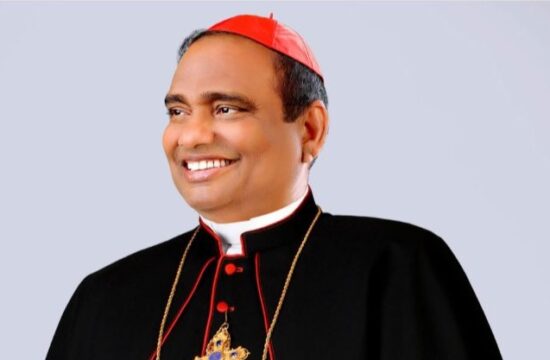
“Poverty does not change with baptism.” With this pointed observation, Cardinal Anthony Poola has drawn attention to the continuing exclusion of Dalit Christians, who, despite converting to Christianity, remain vulnerable to caste discrimination but are denied the constitutional benefits available to Dalits belonging to other religious communities.
In an exclusive interview with AdVaticanum, published on November 16, Poola, India’s first Dalit cardinal and president of the Catholic Bishops’ Conference of India (CBCI), spoke about the challenges confronting Dalit Christians, the persistence of caste within Christian communities and the wider concerns surrounding religious freedom and violence against Christians in the country.
Born into a Dalit Christian family in Poluru, in Andhra Pradesh’s Kurnool district, Poola recalled growing up in poverty and experiencing the social exclusion familiar to many Dalit families. His father was a catechist with the Mill Hill Missionaries, and the Church was central to his family life. Poola said missionaries and other benefactors helped him continue his education after poverty forced him to leave school.
Reflecting on the position of Dalits who embrace Christianity, Poola said they lose access to government benefits available to Dalits of other religions, including reservations in education and employment and scholarships. He called for this discrimination to be addressed through peaceful and legal means.
The exclusion has its roots in Paragraph 3 of the Constitution (Scheduled Castes) Order, 1950, which restricts Scheduled Caste recognition to members professing Hinduism, Sikhism or Buddhism. Sikhs were included in 1956 and Buddhists in 1990, but Christians remain outside its ambit. The Supreme Court upheld the constitutional validity of the religious restriction in the 1985 Soosai v. Union of India judgment. The demand to extend SC recognition to Dalit Christians has since remained a central issue in the community’s struggle for equal rights. The Ranganath Misra Commission, which examined the status of religious minorities, also recommended removing the religious restriction.
Caste discrimination persists within Christian communities
Poola’s remarks also draw attention to an uncomfortable reality: caste discrimination has not disappeared with conversion, and the Church itself has not been immune to it.
While acknowledging that untouchability was abolished by law and that education had brought progress, he said caste-based attitudes continued in many places, sometimes even within Christian communities. He stressed the need for sustained efforts to remove these practices.
The issue is particularly significant for a community whose demand for Scheduled Caste recognition rests on the argument that conversion does not erase the historical and social disadvantages associated with caste. Dalit Christians continue to seek the restoration of constitutional protections and affirmative-action benefits denied to them under the existing religious restriction.
For Poola, the Church’s responsibility towards the poor must extend beyond charitable work to confronting the discrimination that persists within its own institutions and communities.
Anti-conversion laws and the growing insecurity of Christians
The interview also addressed the challenges facing Christians amid the introduction of anti-conversion laws in several Indian states. Poola maintained that the Constitution guarantees citizens the freedom to profess, practise and propagate religion. He said the Church does not believe in conversion through force or inducement, but expressed concern over the alleged misuse of these laws to harass ordinary people, including pastors conducting prayer meetings and families gathering for celebrations.
On violence against Christians, Poola described the situation in Manipur as a source of deep sorrow and said the Church’s response had included relief camps, food, shelter, education for displaced children and trauma care. He said the Church was also approaching the authorities through appropriate channels to demand that the rule of law be upheld.
Speaking about incidents in his home state of Andhra Pradesh, where he served as Bishop of Kurnool for 12 years, Poola said he felt such developments personally. He urged Christians not to respond to violence with anger, but to pursue justice through peaceful and lawful means.
As CBCI president, he said bishops regularly shared their concerns about attacks on Christians. While civil society and ecumenical organisations were documenting an increase in incidents, he refrained from giving figures without adequate verification. He also pointed out that many incidents, particularly in villages, remained unreported because victims were poor, afraid or unaware of where to seek help.
Poola called for dioceses to document incidents carefully and stand alongside victims. He also emphasised the importance of building bridges with people of other faiths, noting that many Hindu and Muslim neighbours did not support the hatred directed at Christians.

A growing Church rooted in service to the poor
Despite these challenges, Poola described the future of the Indian Church as hopeful. He cautioned against comparing the Church in India with those in Europe in terms of decline or growth, but said faith in India continued to be lived as a family and community reality.
He attributed the vitality of the Church in part to its presence among the poor through schools, dispensaries and hostels for children. For him, faith and charity were inseparable, and the Church rediscovered its purpose when it reached people on the margins.
Poola also urged the Church in the West to understand that Christianity was not foreign to India. Referring to the tradition tracing Indian Christianity to the Apostle Thomas, he described it as an old and distinctly Indian community — a small minority, but one that remained joyful, active and committed to contributing to the country’s future.
His message to Catholics abroad was to remain informed, support the education of poor children and stand in solidarity with people facing persecution, irrespective of their religion.
For Poola, the measure of India’s progress is ultimately not its economic growth alone, but the condition of its weakest citizens. Millions may have moved out of extreme poverty, he acknowledged, but insecure employment, children leaving school to work, unprotected migrant labourers and families unable to afford healthcare remain pressing concerns.
The cardinal’s reflections bring the Dalit Christian question into this wider conversation about poverty, dignity and religious freedom. His own journey from a Dalit family in rural Andhra Pradesh to the highest ranks of the Catholic Church is significant. But his observation that poverty and caste do not disappear with baptism is a reminder that representation at the top cannot, by itself, resolve the inequalities experienced by the community at the grassroots.