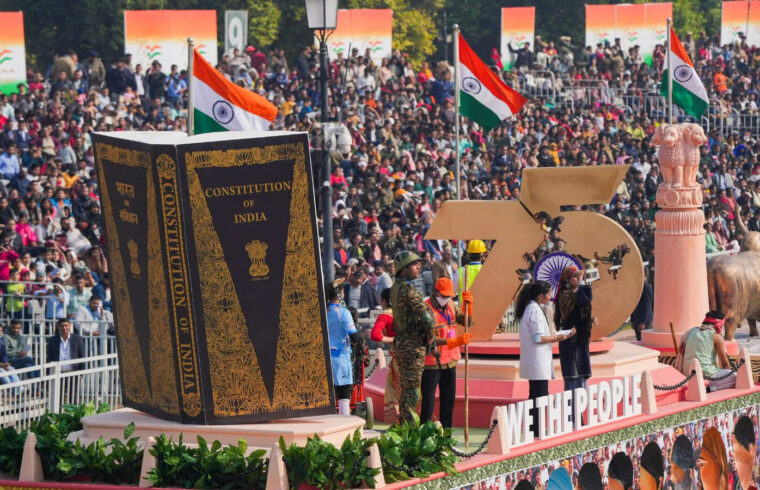
 A tableau celebrating 75 years of Constitution of India on display | Photo Credit: PTI
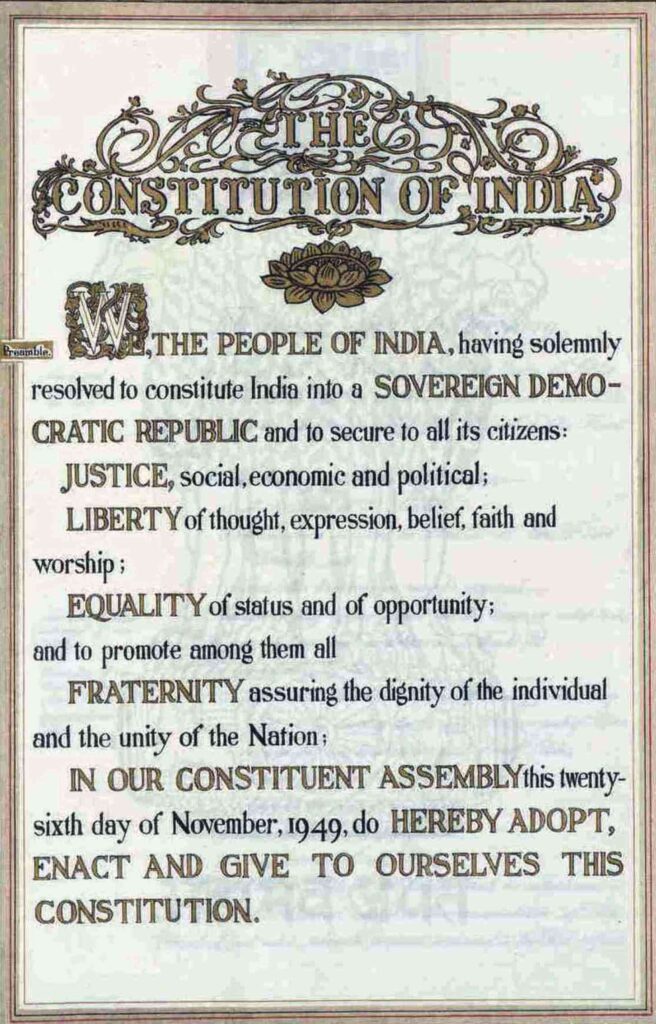
Every November 26, India returns to the words that set out the promise of its Constitution: justice, liberty, equality and fraternity. The Preamble, adopted along with the Constitution by the Constituent Assembly on November 26, 1949, speaks of a republic in which every citizen is entitled to dignity and equal protection. Yet, for some of the country’s most marginalised communities, the distance between that promise and everyday reality remains considerable.
For Dalit Christians and Dalit Muslims, the question of equality is particularly complicated. They continue to experience the consequences of caste in social and economic life, but their religious identities place them outside the constitutional category of Scheduled Castes. Their struggle is, therefore, not simply for access to welfare benefits. It concerns whether a person’s constitutional rights and protections should depend on the religion they profess.
The Constitution Day observance, then, offers an opportunity to look beyond ceremonial readings of the Preamble and examine the claims of communities that continue to seek equal recognition.
When conversion becomes a condition for exclusion
The roots of this exclusion lie in Paragraph 3 of the Constitution (Scheduled Castes) Order, 1950. The original order restricted Scheduled Caste recognition to persons professing Hinduism. Subsequent amendments extended this recognition to Sikhs in 1956 and Buddhists in 1990, while Christians and Muslims remain excluded.
The consequences are significant. Dalits who embrace Christianity or Islam lose access to Scheduled Caste reservation benefits and certain protections attached to that status, even when the social discrimination associated with their caste background does not disappear.
The argument advanced by Dalit Christian and Muslim organisations is that conversion does not erase caste or its consequences. A person’s access to constitutional protection, they maintain, should not be determined by religious identity when the historical and social disadvantages associated with caste continue.
A study commissioned by the National Commission for Minorities, Dalits in the Muslim and Christian Communities, prepared by sociologist Satish Deshpande with Geetika Bapna, examined the persistence of caste hierarchies and social disadvantage within both communities. The report also documented the legal and constitutional questions surrounding the exclusion of Dalit Christians and Muslims from Scheduled Caste recognition.
The demand has consequently brought together Christian and Muslim organisations, civil society groups and advocates of social justice. On August 10 this year, Dalit Christians and Dalit Muslims observed a National Day of Prayer and Protest across the country, renewing their demand for Scheduled Caste status. The observance included prayer meetings, demonstrations, seminars and public representations to government authorities.
The National Council of Churches in India (NCCI) and the Catholic Bishops’ Conference of India (CBCI) Office for Scheduled Castes and Backward Classes also organised a consultation at the Church of North India Bhawan in New Delhi. Participants discussed legal action, public awareness and coordinated advocacy for the rights of the two communities.
Equality must extend beyond religious identity
The concerns of Dalit Christians and Muslims sit within a larger constitutional question: whether freedom of conscience can be meaningfully exercised when changing one’s religion can result in the loss of certain protections.
Articles 14 and 15 guarantee equality before the law and prohibit discrimination on specified grounds, including religion, race, caste and sex. Article 17 abolishes untouchability, while Article 25 guarantees freedom of conscience and the right to profess, practise and propagate religion. These provisions establish a framework in which equality and religious freedom are fundamental to citizenship.
The continuing demand for Scheduled Caste recognition raises questions about how these guarantees should be interpreted alongside the 1950 Order. For Dalit Christians and Muslims, the issue is whether the state can recognise the consequences of caste discrimination without making that recognition conditional on religious affiliation.
The demand is also a reminder that caste cannot be understood solely through the boundaries of religious communities. Social hierarchies and discriminatory practices have persisted in different forms among both Christians and Muslims, as the National Commission for Minorities’ study documented.
Churches raise concerns over constitutional freedoms
Religious organisations have also used Constitution Day to underline the need to protect India’s plural and secular character.
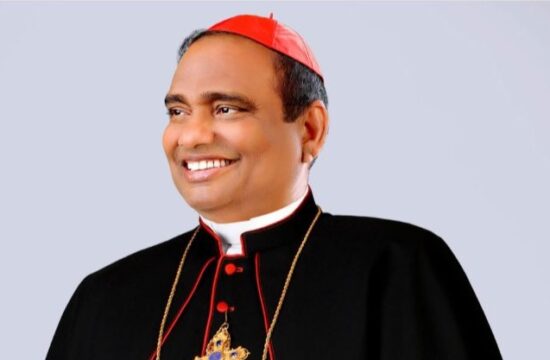
In a message issued ahead of November 26, CBCI president Cardinal Anthony Poola called on the Union and state governments to protect the constitutional rights of all religious minorities and act promptly and impartially whenever those rights are violated. He warned that questioning an Indian citizen’s place in the country on the grounds of religion, language or community violated the spirit of the Constitution.
“I condemn attacks on Christians and on members of other minority communities,” Poola said, appealing to governments to protect every community. He also urged Catholic institutions across the country to study the Constitution, particularly its Preamble, and reflect on the values that guide national life.
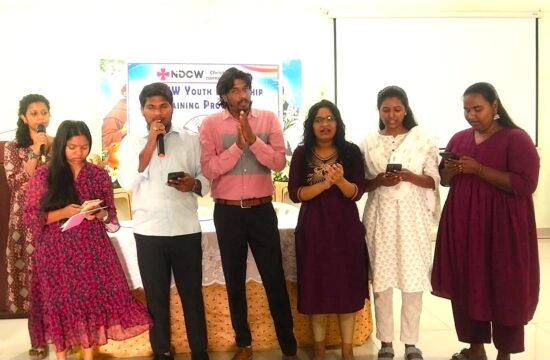
The National Dalit Christian Watch (NDCW), founded in 2016, has sought to take these concerns beyond statements of principle through sustained mobilisation and advocacy. Its work includes leadership and capacity-building programmes for Dalit Christian youth and women, state-level consultations, public hearings and fact-finding missions into allegations of caste discrimination within Church institutions and wider society. The organisation has also pursued representations and advocacy with Church leaders and government authorities, including on the demand for Scheduled Caste recognition for Dalit Christians. Its activities have expanded through state chapters and regional networks; by March 2026, NDCW reported a presence in 15 states and said more than 1,100 people had participated in its capacity-building initiatives.
The United Christian Forum (UCF) has raised similar concerns. Speaking to UCA News ahead of Constitution Day, its convenor A.C. Michael said it was important to remind citizens of the Constitution’s significance at a time when, in his assessment, its fundamental principles were being sidelined. Michael said the forum had recorded 474 incidents of violence against Christians through its helpline between January and October 2026. These are figures reported by the organisation, rather than official government statistics.
In another recent representation, the UCF submitted a memorandum to the Union Home Minister during his visit to Itanagar on November 20, raising concerns over the Arunachal Pradesh Freedom of Religion Act, 1978, the proposed Foreign Contribution (Regulation) Amendment Bill, 2026, and the protection of Christians. The forum called for safeguards against arbitrary complaints and arrests, and for impartial action against violence and disruption of peaceful religious activities.
Beyond the reading of the Preamble
The Constitution Day programme announced by the Union government includes readings of the Preamble in 23 languages, quizzes, discussions and activities in educational institutions across the country. These initiatives seek to familiarise citizens, particularly young people, with the Constitution and its democratic values.
But constitutional awareness must also involve listening to those who continue to struggle to secure its promises. For Dalit Christians and Muslims, that means addressing the denial of Scheduled Caste recognition. For religious minorities more broadly, it means ensuring freedom of conscience, protection from violence and equal treatment before the law.
The Constitution does not promise equality only to those who belong to a particular religion, caste or community. Its promise is universal. The test of that promise lies in whether it protects those who have the least access to power and whose claims for justice are most easily overlooked.
Seventy-seven years after its adoption, the Constitution remains a living document whose values require more than annual observance. For communities still seeking recognition and protection, the Preamble is not merely a set of words to be read on November 26. It is a promise they continue to ask the country to fulfil.